



General Meeting
Astronomy Fundamentals Meeting
Next (ONLINE): Thursday, April 9, 2026
6:30 – 8:00 PM

Come join us for a presentation from the fundamentals of amateur astronomy. Learn your way around the night sky to add to your observing enjoyment. Meetings are on the second Thursday of each month.
You can find our past recordings on the Club’s YouTube channel
https://www.youtube.com/playlist?list=PLXbeCAsGDdSZlqE0IAEUBmZxvmCUJi5Tr
Contact: Connor Justice
Email: fundamentals[at]tucsonastronomy.org
Solar Telescope Observing @ Saguaro NP – East
December 20 @ 1:00 pm – 3:00 pm
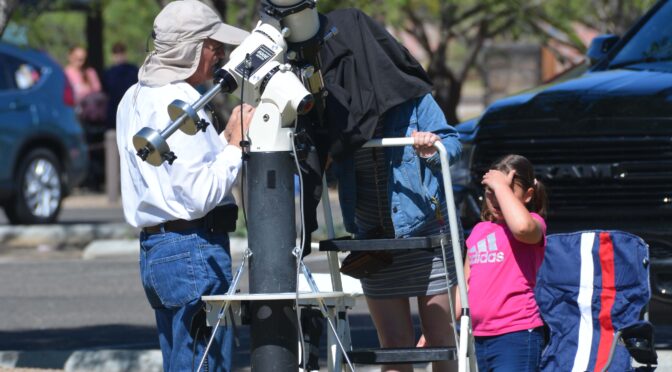
Join the Tucson Amateur Astronomy Association (TAAA) and Saguaro National Park – East District, for some Sun gazing at the park. We will observe the Sun through telescopes with appropriate filters so you will get to see sunspots, prominences, flares, and more.
The Sun is at its peak in the sunspot cycle so there is LOTS of activity on its surface.
This event is FREE and open to the public, no reservations required. NPS admission fees apply.
The telescopes will be set up at the entrance to the Visitors Center.
This event will most likely be canceled in the event of clouds/rain.
Bernie Stinger
612-396-8839
astronomy-events@tucsonastronomy.org
Stargazing at Agua Caliente Park
December 12 @ 6:00 pm – 8:00 pm
Viewing Location: Bus Lanes @ North end of Parking Lot
Information: Great dark skies in Northeast Tucson. Star Party open to the Public. Cost: FREE.
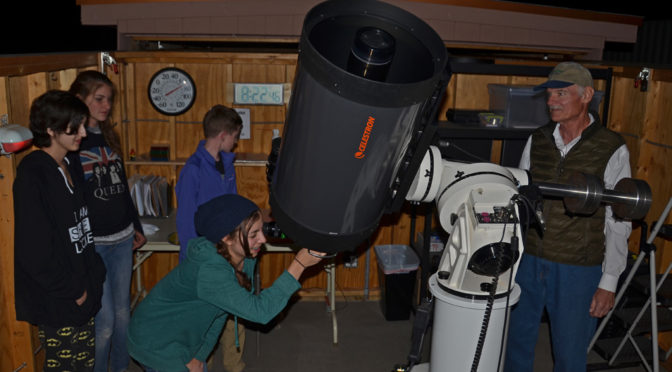
Tucson Amateur Astronomy Association will have several telescopes for astronomical viewing. We will observe Planets, Nebulae, Galaxies, Star Clusters and lots more. Great opportunity to look through a variety of telescopes.
Park gate may close before event end time, so arrive as close to start time as possible. Weather dependent.
For real-time updates, follow this event on the Tucson Amateur Astronomy Association Facebook Events Page: ((4) Tucson Amateur Astronomy Association | Facebook)
FREE but REGISTRATION IS REQUIRED.
These events fill up fast so recommend registering early.
To Register go to: www.DiscoverNature.pima.gov Then Log in or Create an account. Once logged in click on the “Environmental Education Programs” square. You should get the Pop-up screen “Register for a Program”. Scroll down to the event on the list or type in “Stargazing” into the keyword search. Once you find your event click on the “Register” button to the right. You must be logged in for the Registration screen to work.
Bernie Stinger
612-396-8839
astronomy-events@tucsonastronomy.org
Stargazing at Catalina State Park
December 11 @ 6:00 pm – 8:00 pm
Star Party at Catalina State Park – Tucson, AZ
Viewing Location: Ringtail Group Campsite area. Parking available at the Gila Monster & Flycatcher Group campsite areas.
Great dark skies just north of Tucson at Catalina State Park.
Star Party open to the Public. Admission fee for entrance into Catalina State Park.
Tucson Amateur Astronomy Association will have approximately 10 telescopes for astronomical viewing.
We will observe Planets, Nebulae, Galaxies, Star Clusters and lots more. Great opportunity to look through a wide variety of telescopes.
Weather dependent. For real-time updates, follow this event on the Tucson Amateur Astronomy Association Facebook Events Page ((4) Tucson Amateur Astronomy Association | Facebook).
Additional details will be posted here and on our Facebook Event Page as we get closer to the event.
Bernie Stinger
612-396-8839
astronomy-events@tucsonastronomy.org
Stargazing at Saguaro National Park – East Side – Temp Venue change.
November 27 @ 6:00 pm – 8:00 pm
Star Party – Saguaro National Park – East Side
Now at their Desert Learning Center
12661 E Broadway Blvd, Tucson, AZ 85730
Map Coordinates: 32.22239965337127, -110.72231843802784
Drive to the end of Broadway Blvd, parking is limited along roadside. Guides will give directions, short walk to site.
Great dark skies on the East side of Tucson at Saguaro National Park – East Side’s Desert Learning Center. Please do not go to the National Park entrance, it will be closed due to construction.
Star Party is open to the Public. Event is free but NPS admission fees apply.
The Tucson Amateur Astronomy Association will have several telescopes for astronomical viewing. We will observe Planets, Nebulae, Galaxies, Star Clusters and lots more.
Great opportunity to look through a variety of telescopes.
Weather dependent. For real-time updates, follow this event on the Tucson Amateur Astronomy Association Facebook Events Page: Tucson Amateur Astronomy Association | Facebook
Bernie Stinger
612-396-8839
astronomy-events@tucsonastronomy.org
Stargazing @ Canoa Ranch
November 20 @ 6:00 pm – 8:00 pm
Join the Tucson Amateur Astronomy Association (TAAA) and Pima County Conservation Lands and Resources (CLR) for some stargazing at Historic Canoa Ranch.
Our volunteer astronomers with their telescopes will observe planets, star clusters, multiple star systems, nebulae, galaxies, and lots more.
Weather dependent. For real-time updates, follow this event on the Tucson Amateur Astronomy Association Facebook Events Page: Tucson Amateur Astronomy Association | Facebook
To Register go to: www.DiscoverNature.pima.gov
Then Log in or Create an account. Once logged in click on the “Environmental Education Programs” square. You should get the Pop-up screen “Register for a Program”. Scroll down to the event on the list or type in “Stargazing” into the keyword search. Once you find your event click on the “Register” button to the right. You must be logged in for the Registration screen to work.
These events fill up quickly.
Bernie Stinger
612-396-8839
astronomy-events@tucsonastronomy.org
Stargazing @ Picacho Peak State Park
November 13 @ 6:00 pm – 8:00 pm
Truely dark skies at a scenic location – Picacho Peak State Park
Star Party is open to the Public. Event is free but park admission fees apply.
The Tucson Amateur Astronomy Association will have several advanced amateur telescopes for astronomical viewing.
We will observe Planets, Nebulae, Galaxies, Star Clusters and lots more.
Great opportunity to look through a variety of telescopes at a really dark location.
Weather dependent. For real-time updates, follow this event on the Tucson Amateur Astronomy Association Facebook Events Page: https://www.facebook.com/TucsonAstronomy/events
Bernie Stinger
612-396-8839
astronomy-events@tucsonastronomy.org
Stargazing at Oracle State Park
November 7 @ 6:00 pm – 8:00 pm
Viewing Location: Kannally Ranch House
- Typically a music event prior, check the park’s website below.
- Star Party telescope viewing (6:00 – 8:00pm)
Information: Great dark skies just north of Tucson at Oracle State Park.
3820 E Wildlife Dr., Oracle, AZ 85623
Star Party open to the Public. Admission fees for entrance into Oracle State Park apply.
Tucson Amateur Astronomy Association will have several telescopes for astronomical viewing. We will be observing the Moon + Planets, Nebulae, Galaxies, and Star Clusters.
Great opportunity to look through a wide variety of telescopes. Weather dependent.
For real-time updates, follow this event on the Tucson Amateur Astronomy Association Facebook event page: TAAA Facebook Events page
Also: Check the Oracle State Park website for additional information and activities that day:
Star Party at Oracle State Park | Oracle State Park (azstateparks.com)
Bernie Stinger
612-396-8839
astronomy-events@tucsonastronomy.org
40 inch Dobsonian at the RMO deck
You must be a trained and certified operator and have a second person dedicated with you to safely operate this large telescope.
In the Details box name the second operator for your visit.
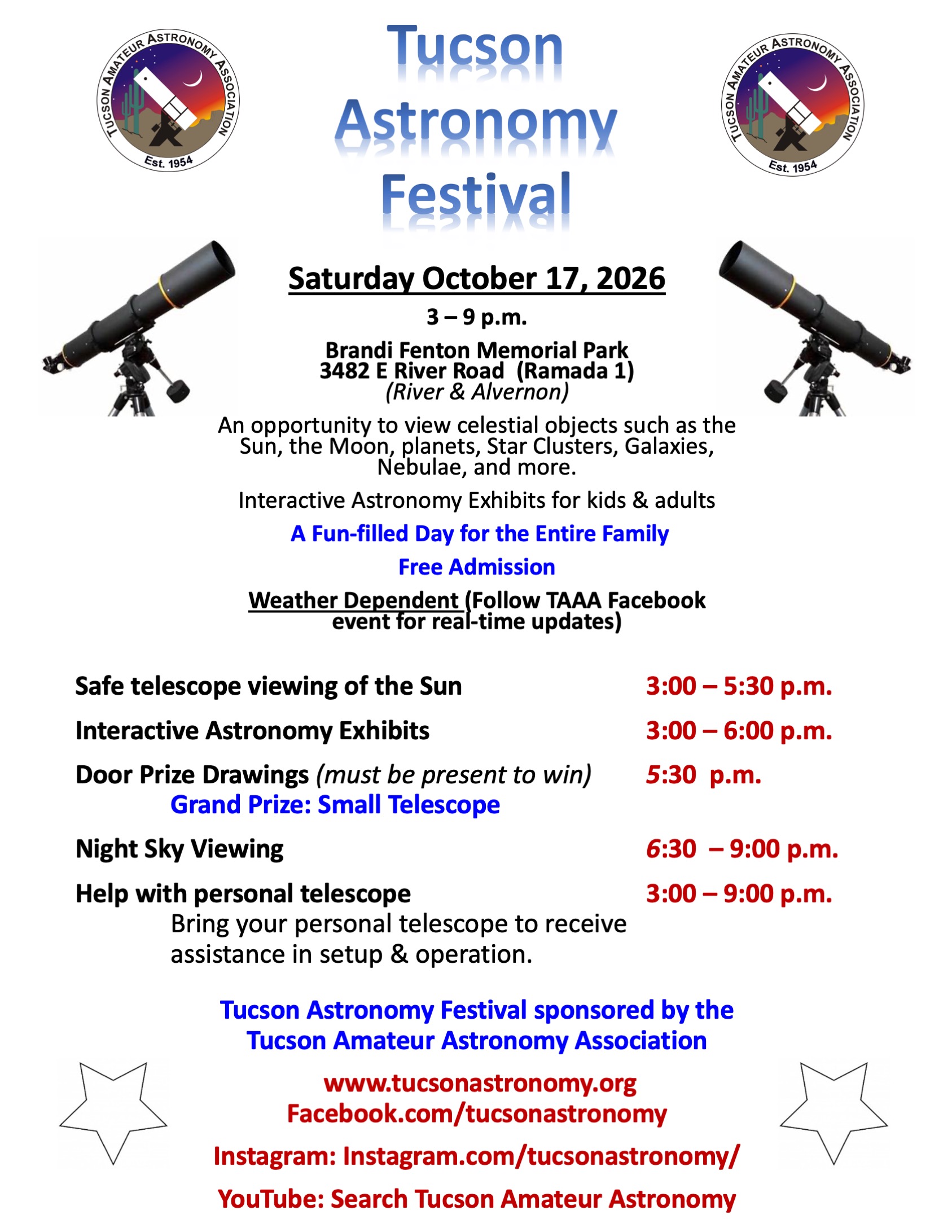
Tucson Astronomy Festival
October 17 @ 3:00 pm – 9:00 pm
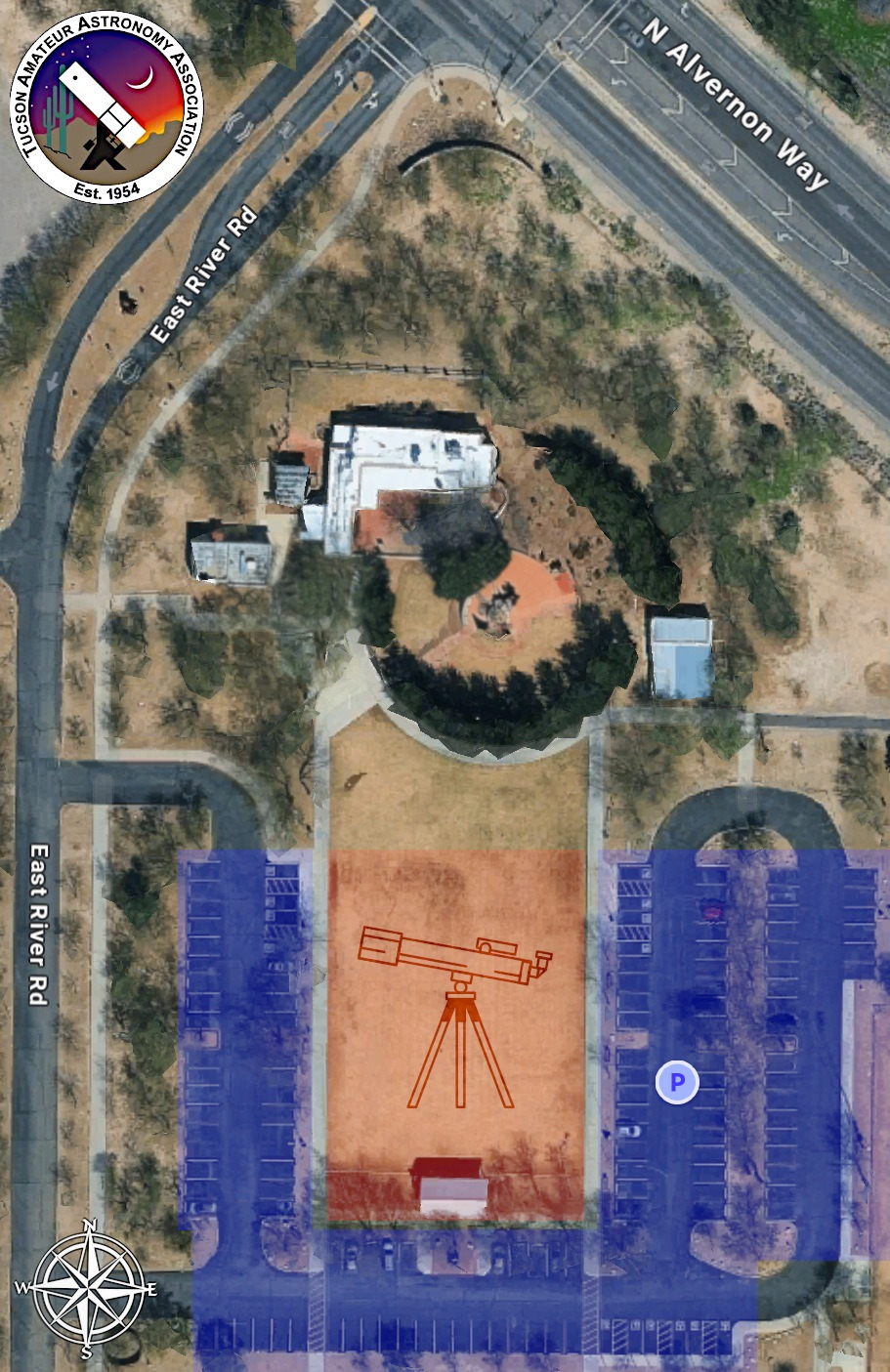
The Tucson Amateur Astronomy Association will host their annual Tucson Astronomy Festival October 17, 2026 at Brandi Fenton Memorial Park in Tucson, AZ from 3 to 9 PM. This is a free family-fun event. Activities include safe telescope observing of the sun and interactive astronomy exhibits in the afternoon, door prize drawing at 5:30 pm (must be present to win) to include a telescope, and Night sky observing of our amazing universe in the evening. The public are encouraged to bring their telescope to receive assistance in set up and operation. To monitor any weather update, follow our Facebook Event at: Tucson Astronomy Festival Facebook Event
Free
Stargazing at Tubac Presidio State Historical Park
October 16 @ 6:30 pm – 8:30 pm
Join us at the Tubac Presidio State Historical Park in Tubac AZ for an evening of stargazing under truly dark skies at an historic location.
TAAA will have volunteer astronomers with Telescopes setup and viewing Planets,
Nebulas, Galaxies, Star Clusters and more, under the dark skies of Southern Arizona!
For more information check out:
Events | Tubac Presidio State Historic Park and Museum
Star Party is free but event is for Tubac Presidio Members only. Membership is available for non-members of the Presidio at the main entrance/gift shop.
Weather dependent. For real-time updates, follow this event on the Tucson Amateur Astronomy Association Facebook Events Page: https://www.facebook.com/TucsonAstronomy/events
Bernie Stinger
612-396-8839
astronomy-events@tucsonastronomy.org